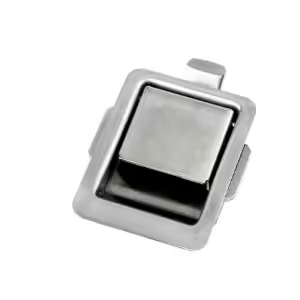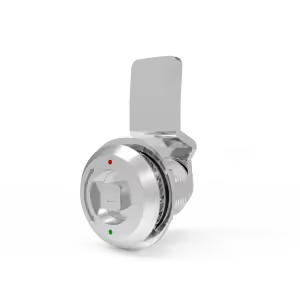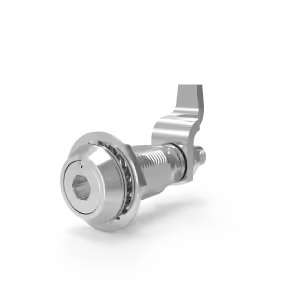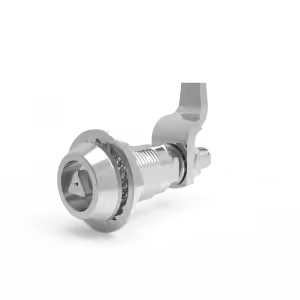





Not all latches survive washdown. Learn why a stainless steel hygienic compression latch for food processing washdown equipment is a hygiene-critical choice.
Picture a routine end-of-shift washdown on a dairy filling line. The operator runs a high-pressure hot water cycle — 80°C water, aggressive alkaline detergent, sustained spray at close range. Every surface on that machine is designed to survive this. The conveyor, the filler heads, the stainless panels — all specified for the environment. And then there’s the enclosure latch: a zinc-alloy compression latch pulled from a general hardware catalog, powder-coated, with a recessed lever handle and a standard rubber gasket. It looks fine. It closes. It seals. Until it doesn’t.
In a food processing washdown environment, the latch is not a minor hardware detail. It is a hygiene-critical interface point between your enclosure and one of the most chemically aggressive cleaning cycles in industrial manufacturing. At Cuyue, we build specifically for this application — not adapted from a general-purpose catalog, but engineered from the ground up for food zone requirements. Here’s why that distinction matters more than most equipment designers initially expect.
What Exactly Happens to a Standard Latch During Washdown?
Why Do Crevices Matter So Much in Food Zones?
In food processing, any undrainable crevice — including the gap between a latch body and a panel surface — is a potential biofilm harbor that survives standard cleaning cycles.
EHEDG Guideline Doc. 8 is explicit on this point: all surfaces in food zones must be self-draining and accessible to cleaning media. A standard compression latch violates this principle almost by definition. The recessed handle pocket, the sharp internal corners around the spindle, the gap between the cam and the panel face — these are all dead zones where liquid pools rather than drains. Biofilm established in these areas is not reliably disrupted by surface spray, because the cleaning medium never reaches the geometry where contamination is actually accumulating.
A hygienic-design compression latch addresses this through radiused external geometry, a sealed spindle that eliminates the exposed threaded shaft, and a body profile that sheds water rather than collecting it. The difference is not cosmetic — it is the difference between a surface that cleans and a surface that looks clean.
What Do Cleaning Chemicals Actually Do to Non-Hygienic Latches?
Alkaline and chlorinated CIP chemicals attack zinc alloys, degrade standard rubber gaskets, and cause paint coatings to blister — all of which introduce particulate and chemical contamination risk into the product zone.
Typical washdown chemical concentrations run sodium hydroxide at 1–3% and sodium hypochlorite at 200–500 ppm. These concentrations are routine in dairy and beverage processing, and they are genuinely corrosive to zinc-based die castings. The zinc surface oxidizes, the coating delaminates, and the resulting particulate enters the cleaning water stream — which in a food zone means it enters the product environment.
Gasket degradation is the more insidious problem. Standard rubber gaskets absorb cleaning agents over repeated cycles. The degradation is often invisible until the latch fails an IP re-test or a hygiene audit catches it. We received an inquiry from a dairy OEM whose existing enclosure latches were failing IP69K re-testing after six months of field use. The root cause was not mechanical failure of the latch body — it was gasket swelling and compression set caused by repeated exposure to alkaline CIP chemistry. The latch still closed. It no longer sealed.
What Standards Actually Govern Washdown Latch Selection?
Selecting a stainless steel hygienic compression latch for food processing washdown equipment requires satisfying at least three overlapping compliance layers: ingress protection rating (IP69K minimum), material traceability (316L stainless with mill certification), and hygienic design certification (EHEDG or 3-A SSI depending on your market.
Is IP69K the Right Ingress Protection Standard for Washdown?
IP69K is the correct minimum standard for food processing washdown applications — it specifically tests resistance to high-pressure, high-temperature water jets (80 bar, 80°C) at close range, which matches real CIP and washdown conditions far more accurately than IP66 or IP67.
This distinction matters because IP66 and IP67 are frequently misapplied in food equipment specifications. IP66 tests resistance to powerful water jets at standard pressure — not the sustained high-pressure, high-temperature spray of a CIP washdown cycle. IP67 tests immersion at shallow depth — relevant for flood scenarios, not spray environments. IP69K was developed specifically because neither of those ratings reflects what actually happens during industrial washdown. Cuyue hygienic compression latches are IP69K tested, and we provide test reports as standard documentation for machine certification packages.
Why Does 316L Stainless Steel Matter More Than “Stainless Steel”?
The designation “stainless steel” covers dozens of alloys — in food processing washdown environments, only 316L (UNS S31603) provides the molybdenum content needed to resist chloride-induced pitting corrosion from CIP chemicals.
The molybdenum content in 316L runs 2–3%, compared to essentially zero in 304. That molybdenum is what drives the pitting resistance equivalent number (PREN): 316L achieves a PREN of ≥ 24, while 304 sits at ≥ 18. The practical threshold for chloride-rich food processing environments is generally accepted as PREN > 23 — meaning 304 stainless falls below the minimum threshold for reliable performance in these conditions, regardless of how it looks on a specification sheet.
Cuyue supplies EN 10204 3.1 mill certificates with heat number traceability for every production batch of 316L components. For pharmaceutical enclosure sealing applications, our elastomeric gasket materials also carry FDA 21 CFR 177.2600 compliance documentation — a requirement we handle as standard, not as a special request.
| Standard / Certification | What It Governs | Minimum Requirement for Washdown Latches |
| IP69K (IEC 60529) | Water ingress protection | High-pressure hot water jet resistance |
| EHEDG Doc. 8 | Hygienic design geometry | No undrainable crevices, Ra ≤ 0.8 µm surface finish |
| 3-A SSI | Dairy/food contact material | 316L SS body, FDA-compliant elastomers |
| FDA 21 CFR 177.2600 | Elastomeric sealing material | Required for pharmaceutical enclosure sealing |
| EN 10204 3.1 | Material traceability | Mill certificate with heat number |
How Should You Specify a Hygienic Compression Latch for Your Enclosure Design?
Specifying the right hygienic compression latch requires defining five parameters before reaching out to any manufacturer: panel thickness and material, required IP rating, grip range (compression stroke), drive type, and the applicable hygiene standard for your end market.
Does Panel Thickness Change Your Latch Selection?
Yes — the grip range directly determines whether the latch achieves a consistent seal, and using a latch outside its specified grip range is one of the most common causes of IP rating failure in the field.
Grip range is the distance between the minimum and maximum panel-plus-gasket thickness the cam can travel across while maintaining adequate compression force on the seal. Common requirements run 3–10 mm for thin stainless sheet enclosures and 10–20 mm for panels with integrated foam gaskets, such as insulated panels on cold-chain processing equipment. Cuyue can customize spindle length and cam geometry for non-standard panel constructions — this is a routine modification, not an exceptional request.
Which Drive Type Works Best in Washdown Conditions?
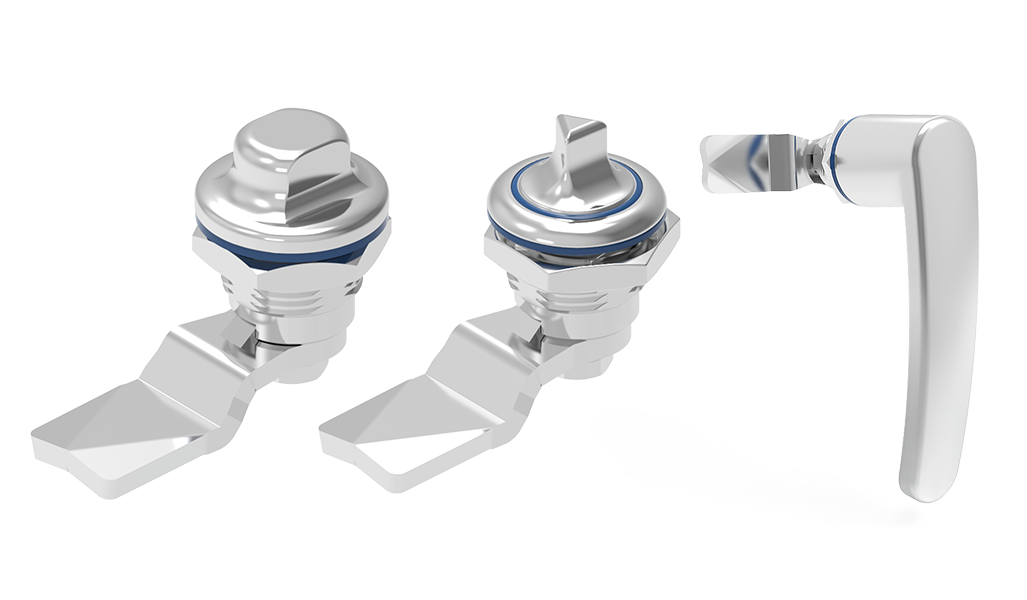
In washdown environments, tool-operated drives (hex key or square drive) are strongly preferred over hand-operated lever handles because they eliminate exposed pivot points and hollow handle profiles that trap moisture and residue.
We specified tool-drive hygienic latches for a beverage filling line OEM in Southeast Asia after their original lever-handle latches failed a hygiene audit due to corrosion at the handle pivot point. The pivot joint on a lever handle is, by geometry, a crevice — and in a high-humidity, high-frequency washdown environment, it corrodes and harbors residue regardless of the base material. A hex or square key drive eliminates the pivot entirely, leaving a flush, radiused surface with no retention geometry for moisture or product residue.
For pharmaceutical enclosure sealing contexts, where Cuyue serves as an FDA compliant compression latch supplier for pharmaceutical enclosure sealing requirements, tool-drive configurations are often combined with tamper-evidence features. We support both standard and tamper-evident drive configurations within the same hygienic latch platform.
What Surface Finish Is Required for Hygienic Compliance?
EHEDG guidelines specify a maximum surface roughness of Ra ≤ 0.8 µm for food-contact and near-contact surfaces — electropolished 316L stainless steel achieves Ra ≤ 0.4 µm, exceeding this threshold and simultaneously improving corrosion resistance.
Surface finish is not just an aesthetic specification. At Ra > 1.6 µm, bacterial adhesion increases significantly because the surface topography provides mechanical anchoring points that survive CIP cycles. Electropolishing removes the outermost layer of material, leveling micro-peaks and enriching the chromium oxide passive layer — the result is both a smoother surface and a more corrosion-resistant one. Cuyue offers both electropolished (Ra ≤ 0.4 µm) and mirror-polished finishes depending on application requirements, with surface finish documentation available for hygiene audit packages.
What Can Cuyue Customize for Your Washdown Application?
At Cuyue, we approach every hygienic compression latch project as an application engineering problem — if your enclosure design, hygiene standard, or operating environment falls outside a standard configuration, we modify the latch to fit your specification, not the other way around.
Which Components Can Cuyue Modify for Your Project?
Cuyue can modify body geometry, spindle length, cam profile, drive type, gasket material, and surface finish — and we can combine multiple modifications in a single custom part with production-ready documentation.
The gasket material selection is often where the most application-specific engineering happens. Our standard options include:
| Gasket Material | Key Properties | Recommended Application |
| Blue-detectable silicone | FDA 21 CFR 177.2600 compliant, visually detectable | Food processing, dairy, beverage |
| EPDM | Steam-resistant, good alkaline resistance | CIP steam environments |
| FKM (Viton) | Aggressive chemical resistance, high-temp stable | Chemical processing, aggressive CIP |
Blue-detectable silicone is the default recommendation for most food processing washdown applications — it is chemically resistant, heat-stable, and the blue pigmentation provides visual detection capability during food safety inspections, which is a requirement on many HACCP-controlled lines.
Every custom configuration includes full documentation support: EN 10204 3.1 material certificates, IP69K test reports, FDA sealing compliance letters, and RoHS/REACH declarations. For customers operating as an FDA compliant compression latch supplier for pharmaceutical enclosure sealing within their own supply chains, we can structure the documentation package to support your downstream qualification requirements.
How Does Cuyue Support Your Qualification and Procurement Process?
Cuyue supports the full qualification cycle from first engineering sample through production release — including material certificates, IP69K test reports, FDA sealing documentation, and PPAP-style documentation packages on request.
Engineering samples for standard hygienic latch configurations ship within five business days. Custom configurations — modified spindle length, non-standard cam profile, alternative gasket material — ship within 15 business days after drawing confirmation. This timeline is not aspirational; it reflects our actual warehouse stock levels and manufacturing capacity for modified-standard parts.
On the documentation side, a European dairy equipment OEM recently required EHEDG-referenced design documentation alongside IP69K test reports for their machine CE marking file. Both were included in our standard qualification package without additional lead time or cost. This is the kind of documentation depth that distinguishes a manufacturer who understands food equipment compliance from one who ships hardware and leaves the paperwork to the buyer.
Cuyue ships to food processing OEMs across Europe, North America, Southeast Asia, and the Middle East. MOQ for most modified-standard configurations starts at 50 pieces, with warehouse stock available for standard hygienic latch configurations for immediate dispatch.
FAQ
What is the difference between IP66 and IP69K for washdown equipment?
IP66 tests resistance to powerful water jets at standard pressure and temperature. IP69K tests resistance to high-pressure (80 bar), high-temperature (80°C) water jets at close range — conditions that directly match food processing washdown and CIP cycles. For food processing washdown equipment, IP69K is the correct minimum rating. IP66-rated latches are not adequate for this environment, regardless of material.
Can Cuyue supply 316L material certificates for every production batch?
Yes. We provide EN 10204 3.1 mill certificates with heat number traceability for all 316L stainless steel components on every production batch, as standard — not on request. These certificates are included in the qualification documentation package and can be referenced directly in your machine technical file.
Are Cuyue’s gasket materials compliant with FDA 21 CFR 177.2600?
Yes. Our standard blue-detectable silicone and FKM gasket options are both FDA 21 CFR 177.2600 compliant. Written compliance documentation is available for your qualification file. This applies to both food processing washdown applications and pharmaceutical enclosure sealing projects.
What is the minimum order quantity for custom hygienic compression latches?
For most modified-standard configurations — adjusted spindle length, alternative gasket material, non-standard drive type — MOQ starts at 50 pieces. More complex body geometry modifications may carry a higher MOQ depending on tooling requirements. Send us your drawing or specification and we will confirm MOQ and lead time within 24 hours.
Does Cuyue’s hygienic latch design follow EHEDG principles?
Our hygienic latch designs follow EHEDG Doc. 8 principles throughout: radiused external geometry, no undrainable crevices, electropolished surfaces to Ra ≤ 0.4 µm, and a sealed spindle design that eliminates the exposed threaded shaft common in standard compression latches. Design documentation referencing EHEDG criteria is available for hygiene audit packages on request.
Every washdown enclosure project has its own constraints — panel construction, chemical environment, hygiene standard, documentation requirements for CE marking or FDA submission. We engage with those constraints at the engineering level from the first conversation, not after you’ve placed an order.