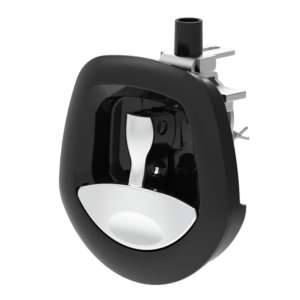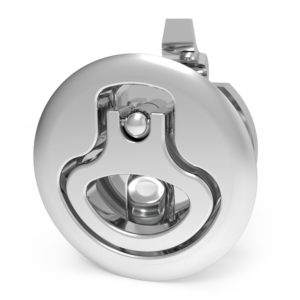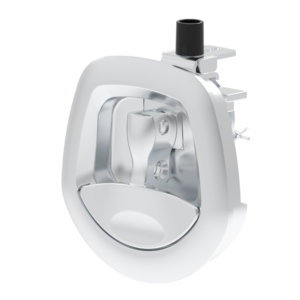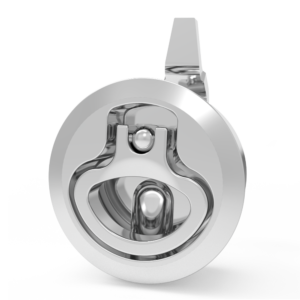





In industrial enclosure design, there is a massive difference between a door that is merely closed and a door that is structurally sealed. Standard cam locks simply swing a metal tongue behind a frame—a passive action that leaves doors vulnerable to rainwater intrusion, acoustic rattle, and vibration fatigue.
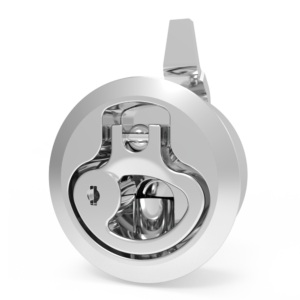
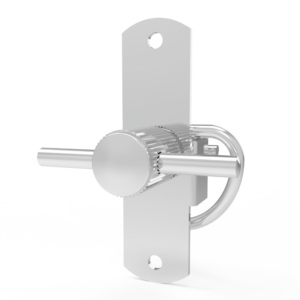
A compression lock (often specified in engineering drawings as a compression latch or compression cam lock) solves this fundamental flaw. Rather than just acting as a physical barrier against unauthorized entry, a compression lock is an active mechanical clamping device engineered to pull a door tightly inward against its frame—compressing the perimeter gasket while locking the panel securely in place.
The Two-Stage Mechanical Advantage: Why Axial Pull-Up Matters
To understand why OEM engineers rely on compression locks for harsh environments, look at how the hardware moves during a single locking cycle:
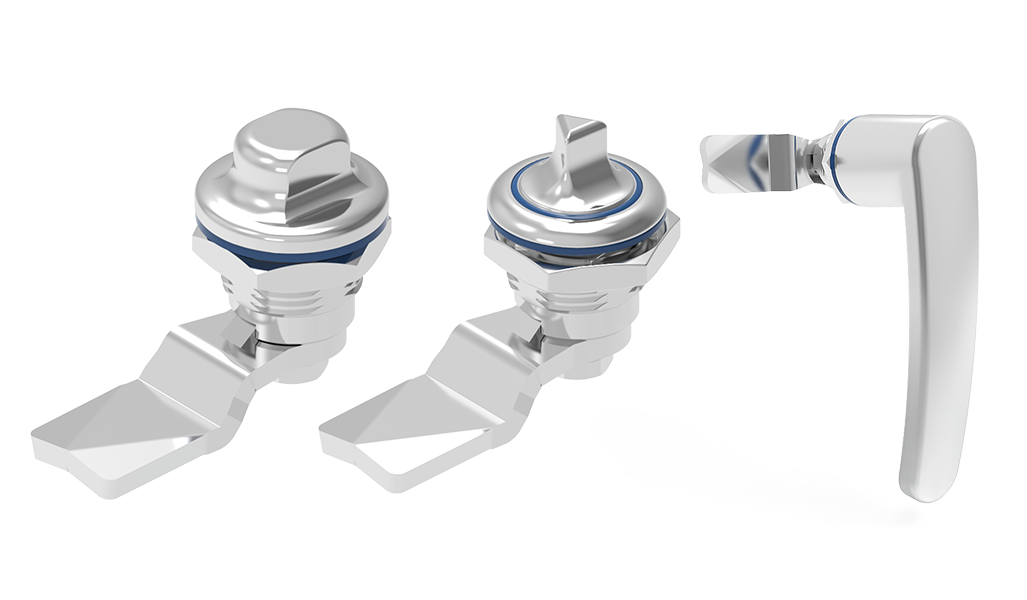
Stage 1 — Rotational Engagement: Turning the key, wing knob, or lift-and-turn handle rotates the internal pawl 90 degrees behind the cabinet frame or keeper. At this point, the door cannot swing open, though the weatherstripping is not yet fully loaded.
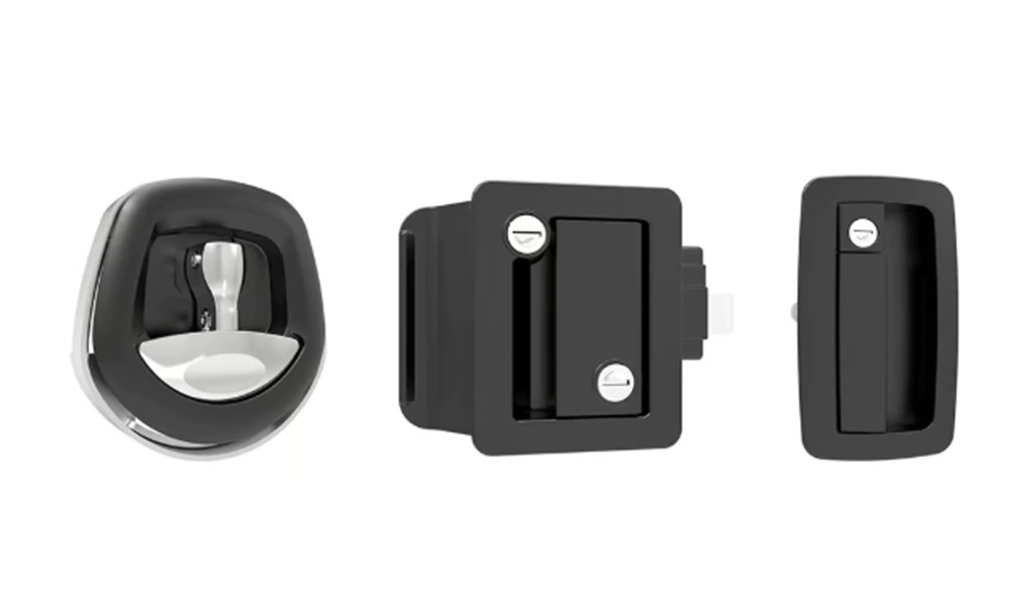
Stage 2 — Axial Pull-Up (Linear Compression): Completing the actuation motion—whether folding down a lever handle, depressing a flush paddle, or turning a threaded spindle—draws the pawl linearly toward the door panel by a controlled pull-up distance (typically 4 mm to 6.5 mm).
This axial clamping force pulls the entire door perimeter into uniform contact with the EPDM or silicone gasket. Just as importantly, when unlatching, a well-engineered compression lock releases axial tension first before rotating the pawl clear of the frame—preventing sideways friction wear and tearing on expensive sealing strips.
Compression Lock vs. Compression Latch: Clarifying Industry Terminology
While industrial hardware buyers frequently use compression lock and compression latch interchangeably, distinguishing the two helps streamline procurement specifications:
Compression Lock: Typically highlights restricted access control and keyed security—integrating pin-tumbler cylinders (such as CH751), tubular keys, or specialized security tool drives (railway triangle, hex, or double-bit) alongside axial compression.
Compression Latch: Refers broadly to the entire mechanical clamping family, including tool-free flush paddle handles, T-handles, and over-center lever latches built for frequent operator access.
Both share the same core engineering mission: combining positive gasket compression with vibration-resistant closure.
Four Critical Enclosure Challenges Solved by Compression Locks
1. Achieving Legitimate IP65/IP66 and NEMA 4/4X Ratings
An electrical or telecom cabinet cannot pass NEMA 4/4X or IP65/IP66 ingress testing unless its perimeter gasket is compressed by roughly 25% to 30% of its original thickness. Sealed compression locks—built with internal shaft O-rings and an under-flange gasket—apply uniform clamping load around the door while blocking water jets, washdown chemicals, and fine airborne dust from entering through the lock cylinder itself.
2. Eliminating Panel Rattle and Harmonic Vibration
On rail transit cars, off-highway agricultural machinery, and acoustic diesel generator canopies, continuous vibration causes ordinary cam locks to buzz, wear down strike plates, and gradually back open. Compression locks featuring over-center locking geometry mechanically lock past their dead-center point, pre-loading the door against the gasket so road shock and engine oscillation cannot shake the latch loose.
3. Preserving EMI/RFI Shielding Integrity
Defense electronics, medical diagnostic systems, and high-density data racks depend on conductive elastomer or beryllium-copper EMI gaskets to block electromagnetic interference. Even a 0.5 mm gap breaks shielding continuity. Compression locks maintain firm, uninterrupted metal-to-gasket contact across extreme thermal cycles.
4. Correcting Door Bowing on Tall Cabinets
Sheet-metal doors taller than 1,000 mm (40 inches) naturally flex outward at the top and bottom corners when secured only at the midpoint. Linking a central compression lock to multi-point rod extensions (2-point or 3-point latching) pulls the top, center, and bottom of the door simultaneously into flush alignment.
Key Specifications to Evaluate Before Sourcing
When selecting a compression lock for an industrial application, engineers should confirm four core parameters:
| Specification | What to Look For | Engineering Impact |
| Grip Range | Distance from the outer door face to the inner frame engagement surface | Fixed-grip models speed up assembly on uniform sheet metal; adjustable-grip models (threaded spindle + locknut) accommodate thick composite doors and long-term gasket compression set. |
| Material & Finish | 316 Stainless Steel, 304 Stainless Steel, or Powder-Coated Zinc Alloy | 316 SS resists marine salt spray and harsh chemicals; 304 SS suits food processing and general outdoor use; zinc alloy offers cost-effective strength for indoor switchgear. |
| Actuation & Keying | Key-locking cylinder, tool-operated drive, or padlockable lever | Balances quick technician access with public tamper resistance and Lockout/Tagout (LOTO) safety compliance. |
| Working Load Rating | Continuous tensile load capacity (measured in Newtons) | Must safely exceed the combined rebound force of the compressed gasket plus external wind or shock loads. |
Complete Industrial Locking System Solutions from CUYUE
Choosing the right compression lock design is only half the battle—consistent manufacturing tolerances and dependable supply are what keep OEM assembly lines moving without costly field failures.
At CUYUE, we are a comprehensive industrial cabinet hardware enterprise dedicated to cabinet locks, hinges, and handles. Supported by an experienced in-house R&D and engineering team, we provide end-to-end industrial locking system solutions tailored to demanding B2B requirements:
Full In-House R&D & Precision Tooling: We control every phase under one roof—from 3D CAD structural design and custom mold development to stamping, die-casting, CNC machining, surface finishing, and final assembly.
Rigorous Laboratory Testing & Validation: Every compression lock series undergoes strict internal quality verification—including mechanical life-cycle endurance, tensile pull-load testing, and ASTM B117 neutral salt spray testing—before shipment.
Agile Customization, Fast Delivery & Cost Control: Whether you require IP65 sealed stainless steel compression locks, custom pawl offsets for unique frame depths, specialized key codes, or integrated multi-point rod assemblies, our vertically integrated production model ensures rapid lead times and competitive factory-direct cost control.
Need 3D CAD files, technical specifications, or custom OEM/ODM engineering support for your next cabinet or equipment project? Reach out to the CUYUE team to specify a compression locking solution built around your exact performance targets.