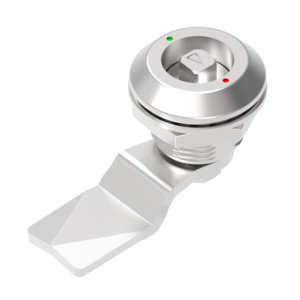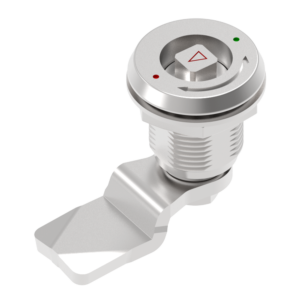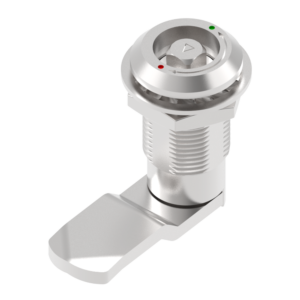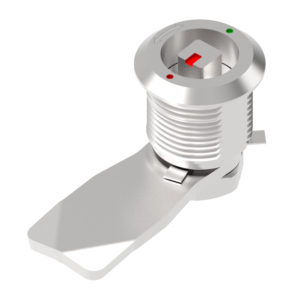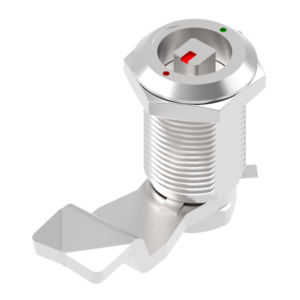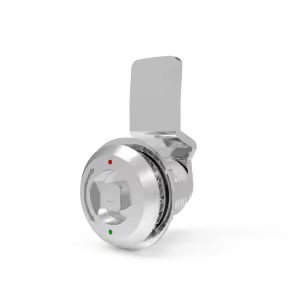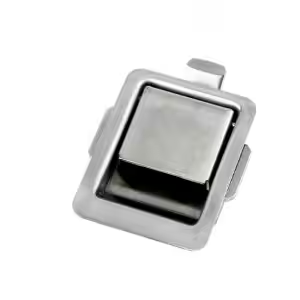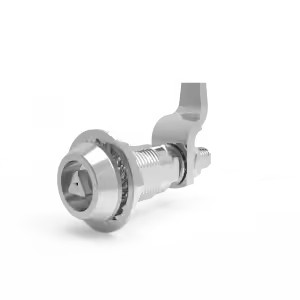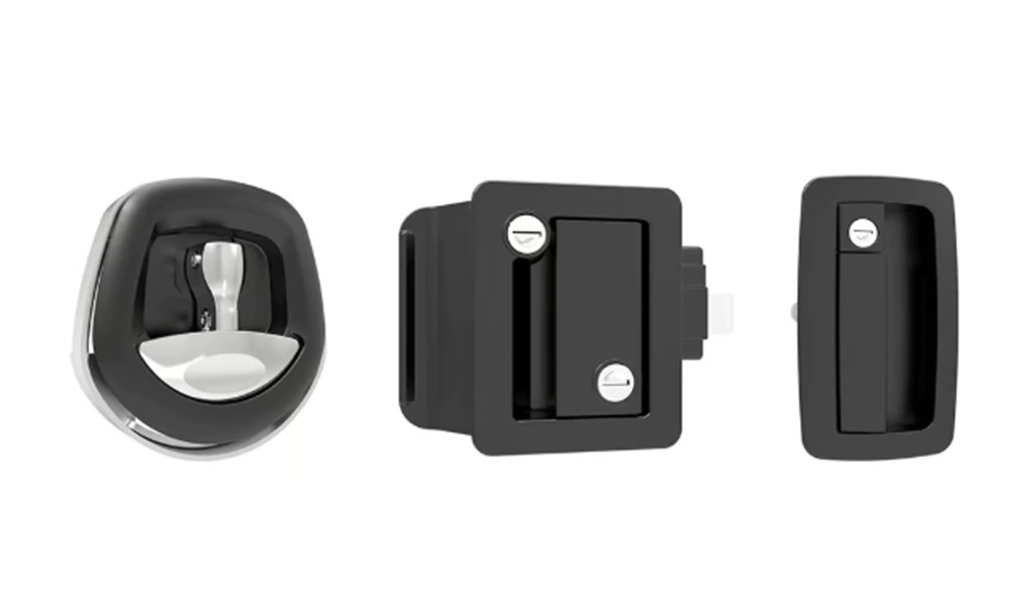
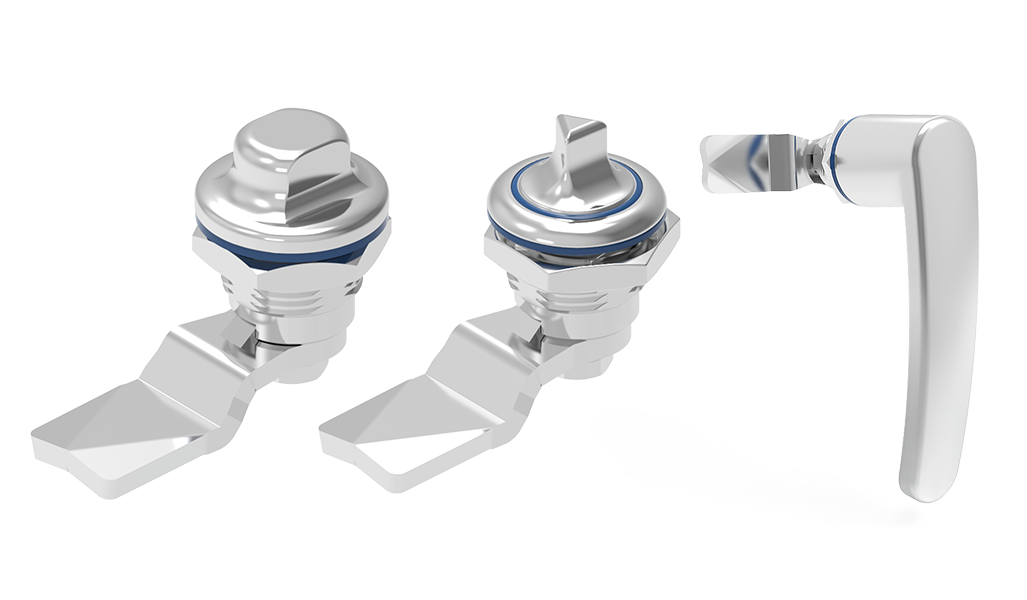





Walk down an assembly line where electrical enclosures or machinery housings are being bolted together, and you will see two fasteners that look remarkably alike from the outside: the standard cam latch and the compression latch. Both mount through a door panel, both use a rotating metal pawl behind the cabinet frame, and both can be operated with a key, tool insert, or handle.
Because they share a similar silhouette, buyers and junior engineers frequently treat them as interchangeable—right up until a cabinet fails an IP65 / NEMA 4 spray test or starts buzzing like a tuning fork next to a running motor.
The core distinction comes down to a single mechanical difference: a standard cam latch only rotates a pawl behind the frame to hold a door closed, whereas a compression latch rotates the pawl and then pulls it straight back toward the door face to clamp the panel tight.
In our daily work reviewing customer enclosure requirements at CUYUE, understanding where passive retention ends and active clamping begins is the single most reliable way to prevent water ingress, eliminate metallic door rattle, and keep hardware budgets under control.
How the Mechanics Differ Behind the Door Panel
To see why these two latches behave so differently in service, look at what happens behind the sheet metal during the closing motion:
Standard Cam Latches: Single-Stage Rotational Retention
When you turn a quarter-turn cam latch 90 degrees, the spindle swings a flat or offset pawl behind the cabinet frame strike. That is the entire mechanical cycle.
The pawl acts as a physical stop that prevents the door from swinging open.
However, it applies virtually zero inward clamping force. If there is a 1 mm gap between the door gasket and the cabinet flange—or if the gasket slowly flattens after a few summers in the sun—that gap stays open.
Compression Latches: Two-Stage Rotation + Axial Pull-Up
A compression latch separates positioning from clamping into two distinct actions:
Stage 1 (Positioning): Turning the handle, lever, or key swings the pawl 90 degrees behind the frame strike without dragging across the metal.
Stage 2 (Axial Clamping): Completing the closing motion—such as folding a T-handle down, snapping a trigger lever flush, or turning a helical cam—draws that pawl straight inward along the spindle axis (typically by 3 mm to 6 mm).
That linear axial pull-up actively squeezes the perimeter EPDM or silicone gasket between the door and the frame, turning a loose sheet-metal door into a tightly pre-loaded structural assembly.
Four Practical Ways This Difference Impacts Your Enclosure
Choosing between a cam lock and a compression latch is not about which hardware is “better”—it is about matching the mechanism to the operating stresses your cabinet actually faces.
1. Environmental Sealing (IP65 / NEMA 4 Compliance)
An elastomer door gasket cannot block pressurized washdown water, driving rain, or fine airborne dust unless it is compressed uniformly—generally by 25% to 35% of its free height. Because a standard cam latch relies solely on how tightly the operator pushes the door shut before turning the key, sealing pressure varies from person to person. A compression latch delivers consistent, repeatable gasket compression every time the handle closes, and sealed models integrate internal shaft O-rings so moisture cannot penetrate through the keyway either.
2. Vibration Resistance and Rattle Control
On mobile equipment, diesel generator canopies, HVAC chillers, and rail transit cabinets, continuous low-frequency vibration slowly backs standard fasteners loose and causes sheet-metal doors to rattle loudly against the frame. Lever-operated compression latches typically utilize an over-center cam geometry: once the handle snaps closed past dead center, vibration and gasket rebound push against a solid mechanical stop rather than working the latch open.
3. Gasket Longevity Over Thousands of Cycles
When you close a conventional cam latch, the rotating metal pawl sweeps sideways directly against the frame or seal, scuffing and tearing the elastomer over repeated openings. Because a compression latch moves the pawl behind the frame before pulling straight inward, there is zero sideways friction during clamping—protecting the gasket on frequently serviced panels.
4. Cost, Cycle Speed, and Sheet-Metal Tolerance
Standard quarter-turn cam latches remain the clear winner for dry indoor electrical panels, office server racks, and utility lockers. They cost less per unit, install rapidly in a single round or double-D cutout, and open with a quick 90-degree wrist turn. Compression latches require a tighter calculation of grip range (measured with the gasket compressed, never relaxed) and carry a higher hardware cost—an investment that pays for itself immediately outdoors or on vibrating machinery, but is unnecessary inside a climate-controlled room.
Side-by-Side Comparison: Cam Latch vs. Compression Latch
| Feature / Performance Factor | Standard Cam Latch (Quarter-Turn) | Industrial Compression Latch |
| Mechanical Action | 1-Stage: 90° rotation behind frame | 2-Stage: 90° swing + linear axial pull-up |
| Clamping Force on Gasket | Minimal (passive door retention only) | High (active, repeatable gasket squeeze) |
| Ingress Protection | Basic dust/splash resistance (indoor use) | High-integrity IP65 / IP66 & NEMA 4 sealing |
| Vibration & Rattle Control | Fair (prone to play and rattle under shock) | Superior (pre-loads door; over-center lock) |
| Gasket Wear | Higher (sweeping pawl rubs strike/seal) | Minimal (straight axial pull avoids drag) |
| Unit Cost & Speed | Lower unit cost; fast quarter-turn access | Higher unit cost; deliberate clamping motion |
| Ideal Applications | Indoor switchgear, lockers, light covers | Outdoor telecom boxes, generators, marine, transit |
How to Decide Which Latch Belongs on Your BOM
Before locking in your enclosure hardware specification, ask three quick questions:
Will the cabinet face rain, washdown hoses, or heavy dust? If yes, specify a compression latch paired with an internal shaft seal and an appropriate 304/316 stainless steel or coated zinc alloy housing.
Is the enclosure mounted on anything with an engine, motor, or wheels? If vibration is present, a standard cam latch will eventually rattle; choose a compression latch to keep the door pre-loaded against its seal.
Is the cabinet indoors, stationary, and opened dozens of times a shift? A standard quarter-turn cam latch gives operators the fastest access at the most economical unit price.
Sourcing Industrial Locking Solutions with CUYUE
Whether your cabinet design calls for cost-effective quarter-turn cam latches, weather-sealed compression latches, or a coordinated hardware package across multiple enclosure lines, working directly with an integrated manufacturer streamlines both engineering and procurement.
At CUYUE, we are a comprehensive industrial locking hardware manufacturer backed by a dedicated R&D and design team, specializing in cabinet locks, industrial hinges, and handles. With complete in-house product R&D, mold development, manufacturing, and product testing and verification capabilities, we deliver end-to-end industrial locking system solutions built to meet growing customer demands for consistent quality, rapid delivery, customization, and disciplined cost control.
Comparing cam latches and compression latches for an upcoming cabinet project? Reach out to the CUYUE team to discuss your cabinet lock, hinge, and handle requirements.