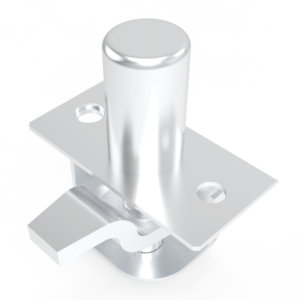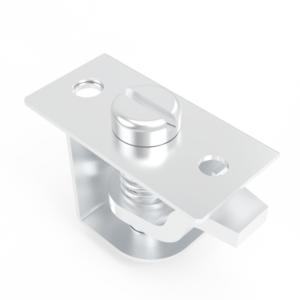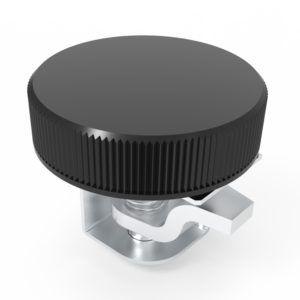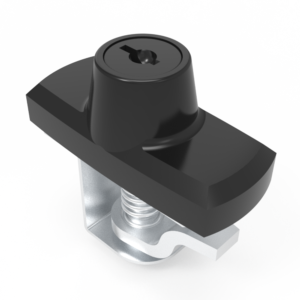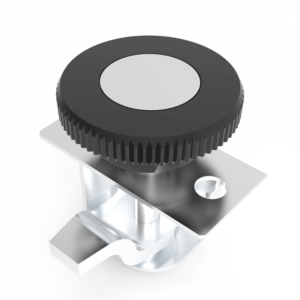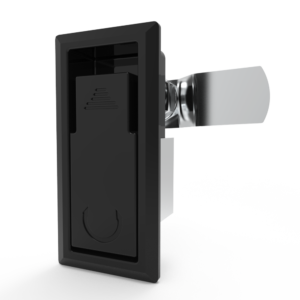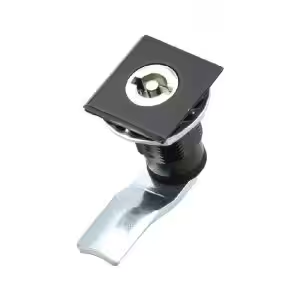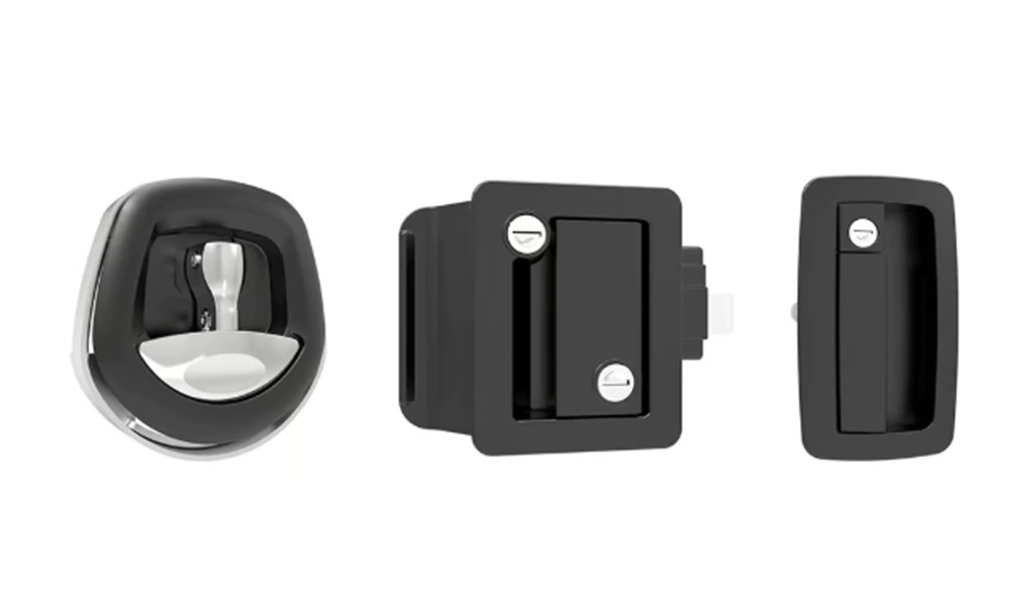
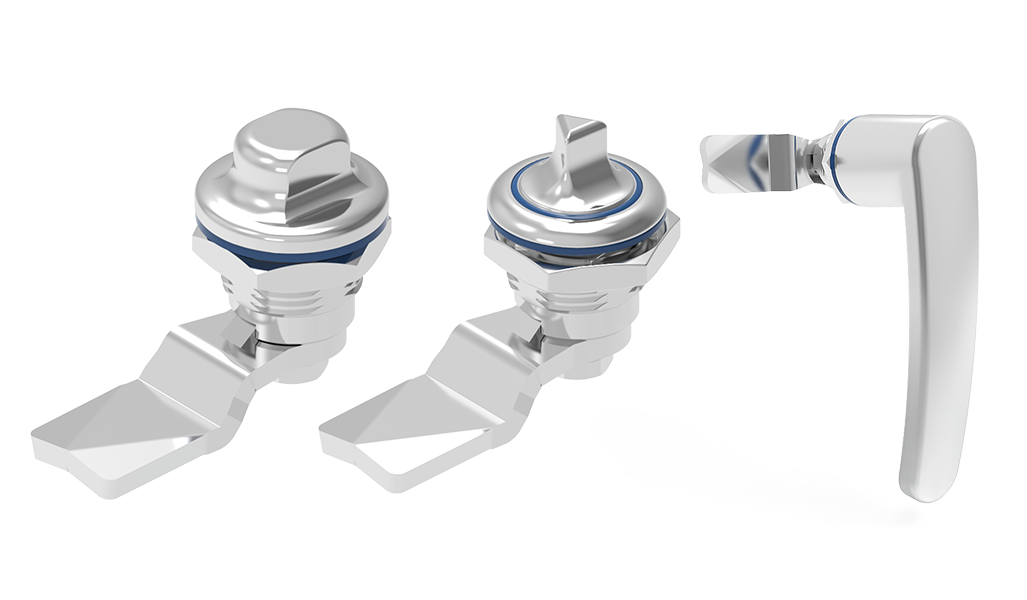





A compression lock (or compression latch) works through a two-stage mechanical sequence: first, it rotates a latching pawl into position behind the door frame; second, it pulls that pawl axially toward the door face to clamp the panel tightly against its perimeter gasket. Unlike standard cam locks that simply hold a door closed, a compression latch applies active clamping force, eliminating rattle, resisting harmonic vibration, and creating a watertight IP65 / NEMA 4 environmental seal.
At CUYUE, our R&D and tooling engineers design and test industrial latching hardware for demanding sectors—from outdoor telecom cabinets and diesel generator canopies to railway rolling stock and off-highway vehicles. Understanding the internal kinematics of a compression lock helps engineers specify the exact grip range, actuation style, and material grade needed to prevent field failures.
The Two-Stage Operating Mechanism Explained
Every industrial compression latch—whether operated by a flush trigger, a T-handle, or a key cylinder—relies on separating rotational positioning from axial pull-up.
Stage 1: Pawl Engagement (Positioning)
When you turn the key, lift the handle, or depress the trigger actuator, the internal spindle rotates the cam or pawl 90 degrees into position behind the enclosure frame (strike plate). Crucially, during this rotation, the pawl has not yet clamped down on the frame. This clearance prevents the metal pawl from scraping across the frame or dragging sideways against the rubber seal.
Stage 2: Axial Pull-Up (Compression & Over-Center Locking)
Once the pawl is behind the frame, continued actuation engages either a helical thread or an over-center cam lever:
Axial Draw: The spindle retracts the pawl straight back toward the door panel—typically by 3 mm to 6 mm (0.12″ to 0.24″) depending on the latch size.
Gasket Compression: This pull-up force compresses the EPDM or silicone perimeter gasket by roughly 25% to 35% of its uncompressed thickness, sealing out dust, pressurized washdown water, and electromagnetic interference (EMI).
Over-Center Self-Locking: In lever-style compression latches, the linkage travels slightly past its mechanical dead-center point. Once past center, external vibration and gasket rebound force push against the stop rather than opening the latch—meaning it cannot vibrate loose on its own.
Common Types of Compression Locks & How Their Mechanisms Differ
Different enclosure designs call for different actuation kinematics. Here is how the four primary industrial compression architectures operate:
| Compression Latch Type | Internal Mechanical Action | Best Industrial Use Cases |
| Trigger / Flush Lever Latch | Pressing a release button pops out a flush handle; pushing the handle back down drives an over-center linkage to pull the pawl tight. | Aerodynamic vehicle compartments, marine hatches, generator doors, sleek server racks. |
| Lift-and-Turn Compression Latch | Lifting the T-handle or L-handle rotates the pawl into place; folding the handle flat drives a cam-follower pin to pull the pawl axially. | Heavy machinery canopies, HVAC units, industrial switchgear enclosures. |
| Vise-Action / Turn-to-Compress Latch | A single continuous half-turn (180°) uses a helical cam track—the first 90° swings the pawl behind the frame, and the second 90° pulls it straight back. | Rail transit cabinets, medical diagnostic equipment, NEMA 4X washdown boxes. |
| Key-Locking / Tool-Operated Cam Compression | Turning a hex key, square railway key, or cylinder key drives a threaded shaft that draws the pawl upward along the spindle threads. | High-security telecom shelters, roadside electrical boxes, tamper-resistant panels. |
Why Compression Locks Outperform Standard Cam Locks
When specifying hardware for outdoor or mobile equipment, replacing a standard quarter-turn cam lock with a compression latch solves three common engineering headaches:
Zero Gasket Tearing (Pure Axial Motion): A standard cam lock sweeps in an arc directly against the frame, grinding the gasket sideways every time an operator closes the door. Because a compression lock positions the pawl before pulling straight back, it preserves gasket integrity over tens of thousands of duty cycles.
Elimination of Metal-on-Metal Rattle: Even a 1 mm gap between a door and frame turns an electrical cabinet into a noise amplifier on moving machinery. Active axial clamping force pre-loads the door structure, eliminating acoustic rattle and fretting wear.
Compensation for Sheet-Metal Tolerances: Powder-coat thickness variations, slight door warpage, or gasket compression set over time can make standard latches either impossible to close or too loose to seal. Most adjustable-grip compression latches feature a threaded shaft or stepped pawl that lets technicians fine-tune the grip range on the assembly line.
Key Specifications to Check Before Selecting a Compression Latch
To ensure proper mechanical clamping without overloading the actuator, engineers should verify four parameters:
Grip Range: The total distance from the outer face of the door panel to the inner latching surface of the frame (accounting for compressed gasket thickness). Choosing a grip range that is too tight will bend the pawl; too loose will fail to compress the seal.
Panel Thickness & Cutout Dimensions: Standardized rectangular or round single-hole cutouts simplify CNC laser cutting and reduce assembly labor.
Static Tensile & Shear Load Ratings: Heavy doors require high-strength zinc alloy (Zamak 5) or 304 / 316 stainless steel bodies rated for 1,500 N to 3,500 N+ of pull force.
Environmental & Corrosion Resistance: Coastal, marine, and chemical environments require passivated 316 stainless steel with internal O-ring shaft seals to prevent water from leaking through the latch cylinder itself.
Engineering Custom Compression Lock Solutions with CUYUE
Standard catalog latches work well for basic sheet-metal boxes, but custom equipment often requires tailored pawl offsets, non-standard grip ranges, custom key codes, or specialized surface finishes.
At CUYUE, we operate as an end-to-end industrial locking hardware manufacturer specializing in cabinet locks, industrial hinges, and handles. With in-house product R&D, precision mold and tooling development, die-casting/CNC machining, and physical load-and-vibration testing labs, our engineering team takes custom enclosure hardware from 3D CAD concept to mass production—delivering strict quality consistency, rapid turnaround times, and competitive OEM unit pricing.
Working on an enclosure project that requires reliable IP65 sealing or custom grip geometry? Reach out to CUYUE’s engineering team with your door-to-frame dimensions and load requirements for tailored latch recommendations and sample validation.