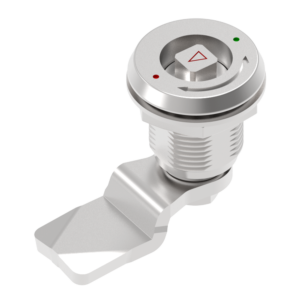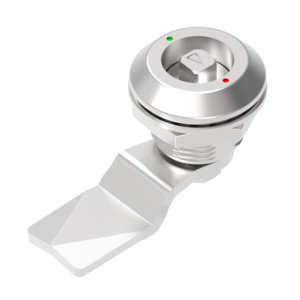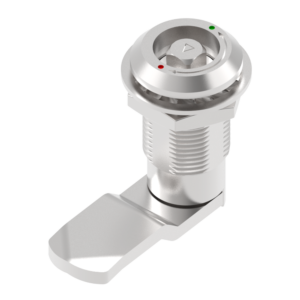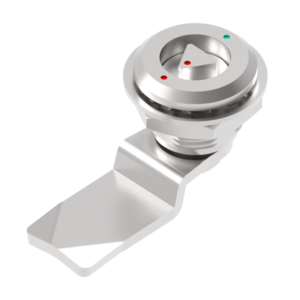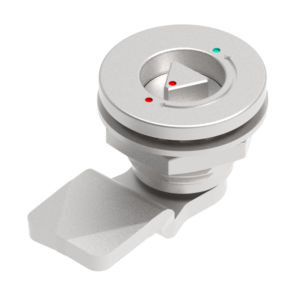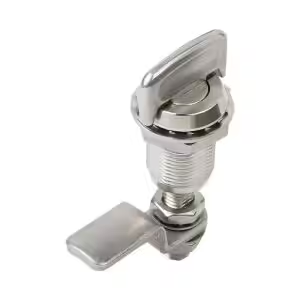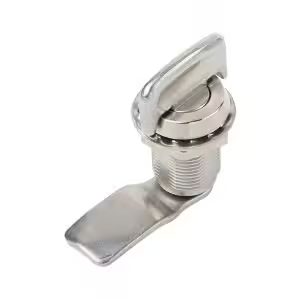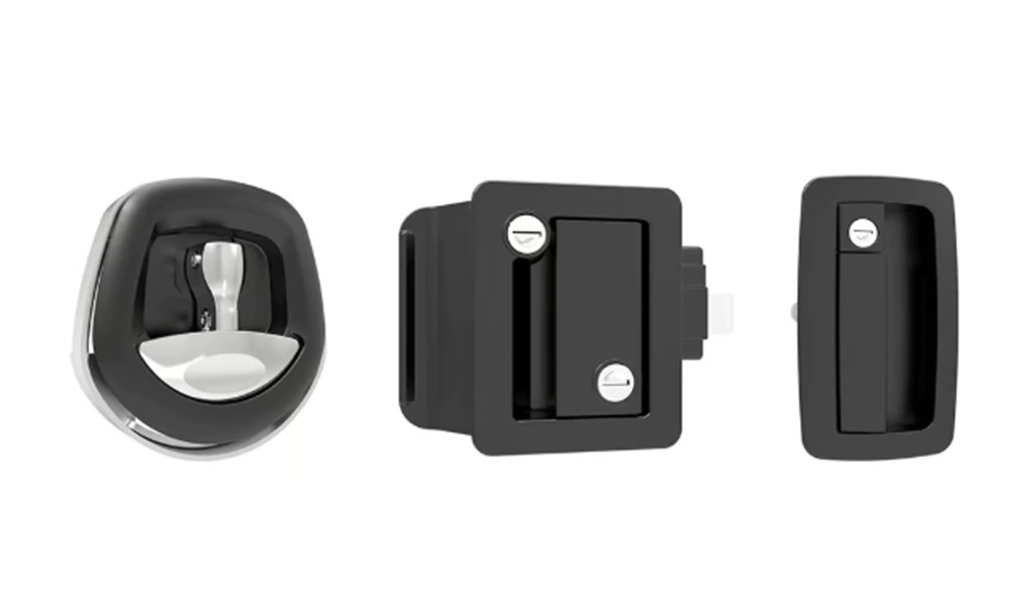
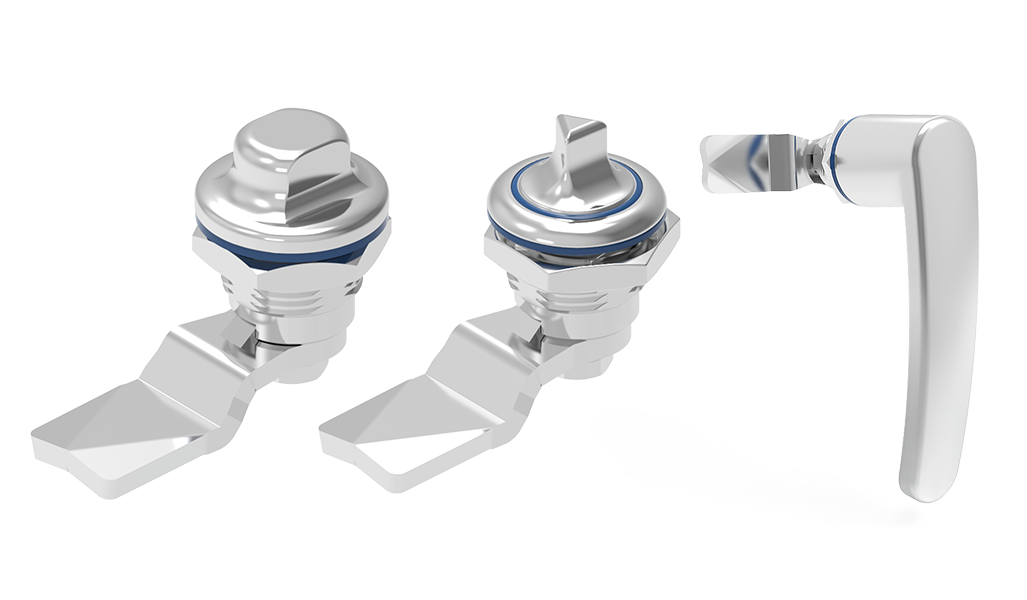





A compression latch is a heavy-duty mechanical fastener engineered to pull a door, hatch, or access panel tightly against its frame—applying continuous axial clamping force to compress a perimeter gasket while securing the closure. Unlike standard cam locks or slam latches that merely hold a door in place behind a strike plate, a compression latch combines rotational latching with a linear pull-up motion in one seamless operation.
For industrial engineers, enclosure fabricators, and OEM procurement teams, compression latches are essential hardware whenever an application requires watertight and dust-tight environmental sealing (IP65/IP66 or NEMA 4/4X), vibration damping, noise suppression, or electromagnetic interference (EMI/RFI) shielding.
How Does a Compression Latch Work?
Most industrial compression latches operate through a two-stage mechanical actuation cycle:
Stage 1 — Rotational Engagement: Turning the handle, lifting the lever, or rotating a key actuator swings the internal cam (pawl) 90 degrees behind the cabinet frame or keeper. At this stage, the door is prevented from swinging open, though the weatherstripping is not yet under full load.
Stage 2 — Axial Pull-Up (Compression): Completing the actuation motion—such as folding down a lever handle, depressing a flush trigger paddle, or turning a threaded spindle—draws the pawl linearly toward the door panel. This axial travel (typically 4 mm to 6.5 mm) pulls the door inward against the frame, compressing the elastomeric gasket to create a positive, rattle-free seal.
When opening the enclosure, the motion reverses: the latch releases gasket compression first before rotating the pawl away from the frame, preventing shear friction and tearing on expensive sealing strips.
Compression Latch vs. Standard Cam Latch: Key Differences
While both components secure industrial cabinet doors, their mechanical performance differs substantially in demanding environments:
| Feature | Compression Latch | Standard Cam Latch |
| Mechanical Action | Rotational engagement + axial pull-up force | Rotational engagement only |
| Environmental Sealing | Compresses perimeter gaskets uniformly (IP65 / NEMA 4X) | Minimal seal pressure; relies on door fitment |
| Vibration Resistance | Eliminates panel rattle and metal-to-metal noise | Prone to rattling under continuous dynamic vibration |
| Door Alignment | Pulls slightly bowed or tall panels flush against the frame | Cannot correct panel deflection |
| Typical Applications | Outdoor electrical enclosures, rail transit, marine, generators | Indoor office cabinets, light-duty lockers, basic service panels |
Main Types of Compression Latches
Industrial compression latches are available in several designs to accommodate different panel thicknesses, mounting profiles, and security requirements:
1. Lever & Flush Paddle Compression Latches
Built with an ergonomic lift-and-turn handle or a recessed trigger mechanism, these latches sit nearly flush with the outer door surface when closed. Their snag-free profile makes them standard on commercial vehicles, utility trailers, agricultural equipment, and acoustic generator canopies.
2. Sealed Compression Latches (IP65 / NEMA 4X)
Equipped with internal O-rings, shaft seals, and under-flange gaskets, sealed compression latches prevent water jets, washdown chemicals, and fine dust from penetrating through the latch housing itself. They are widely used in food-processing machinery, outdoor telecom cabinets, and marine hatches.
3. Adjustable-Grip vs. Fixed-Grip Compression Latches
Adjustable-Grip Latches: Feature a threaded spindle and locking nut that let technicians fine-tune the grip range (the distance from the outer door face to the inner frame surface). This accommodates composite panels, multi-layer doors, and long-term gasket compression set.
Fixed-Grip Latches: Provide a factory-preset pull-up distance ideal for high-volume sheet-metal enclosures with tight manufacturing tolerances.
4. Key-Locking & Tool-Operated Compression Latches
To restrict access on public utilities and high-voltage switchgear, compression latches can be fitted with key-locking cylinders (such as CH751 or tubular keys) or security tool drives (slotted, hex, square, or railway triangle heads).
5. Multi-Point Compression Latch Systems
For tall industrial cabinets exceeding 1,000 mm (40 inches), a single central latch allows the top and bottom corners of the door to flex outward. Multi-point compression systems connect a central actuator to upper and lower rods, distributing uniform clamping pressure along the entire vertical edge.
Core Benefits in Industrial Enclosure Design
Reliable Ingress Protection: Compresses EPDM, silicone, or neoprene gaskets by the recommended 25%–30% deflection ratio to block moisture, salt spray, and airborne particulates.
Shock & Vibration Damping: Over-center locking geometry keeps the latch mechanically locked even under continuous road shock, rail vibration, or heavy engine oscillation.
Extended Hinge & Gasket Service Life: By distributing clamping load evenly and relieving torsional stress on cabinet hinges, compression latches prolong the lifespan of the entire enclosure assembly.
Clean Low-Profile Aesthetics: Flush and recessed designs improve operator safety in tight aisles while giving modern industrial equipment a streamlined, professional finish.
Common Industrial Applications
Electrical & Power Distribution: Outdoor switchgear, solar inverter housings, EV charging stations, and industrial control panels.
Transportation & Heavy Machinery: Rail transit interiors, emergency vehicles, off-highway construction machinery, and refrigerated truck bodies.
Telecommunications & Data Centers: Outdoor 5G base station cabinets, fiber-optic distribution boxes, and server racks.
Marine & Offshore Equipment: Deck hatches, helm consoles, and corrosion-resistant 316 stainless steel shipboard lockers.
HVAC & Acoustic Enclosures: Commercial air-handling units, sound-attenuated generator housings, and CNC machine guards.
Industrial Latching System Solutions by CUYUE
Selecting the right compression latch depends on matching gasket compression, load ratings, and corrosion resistance—such as 304/316 stainless steel or powder-coated zinc alloy—to your exact operating environment.
At CUYUE, we are a comprehensive industrial cabinet hardware manufacturer specializing in cabinet locks, hinges, and handles. Supported by a dedicated R&D and engineering team, we deliver complete industrial locking system solutions tailored to modern OEM demands:
Full In-House R&D & Tooling Development: We manage the entire production lifecycle under one roof—from 3D CAD engineering and precision mold development to stamping, die-casting, CNC machining, surface finishing, and final assembly.
Strict Product Testing & Validation: Every compression latch series undergoes rigorous in-house testing—including cycle endurance verification, tensile pull-load testing, and ASTM B117 salt spray corrosion testing—to guarantee consistent quality in harsh environments.
Customization, Fast Delivery & Cost Control: Whether you need custom pawl offsets, specialized shaft lengths, specific key codes, or integrated multi-point locking assemblies, our vertically integrated manufacturing model ensures rapid lead times and competitive cost control.
Looking for 3D CAD drawings, technical specifications, or custom OEM/ODM engineering support for your next enclosure project? Contact the CUYUE team to specify the ideal compression latch solution for your application.