




By Amie Xu, Sales Manager, CUYUE · Published November
Sourcing industrial cabinet locks looks simple — until the first shipment arrives with inconsistent torque, the finish rusts within six months, or your supplier goes quiet right before a deadline. For procurement managers, OEM buyers, and distributors, a wrong supplier choice rarely stops at “a bad batch of locks.” It turns into production-line stoppages, warranty claims from your own customers, and certifications that don’t survive a customs inspection.
The frustrating part is that almost every supplier’s website says the same thing: high quality, competitive price, fast delivery. None of that is verifiable from a product photo. What actually separates a reliable cabinet lock manufacturer from a trading company with a polished catalog is what happens before you place the order — and what they’re willing to show you.
This 7-point checklist is built from sourcing failures we’ve seen repeat across the enclosure, electrical cabinet, and industrial hardware industry. Use it to screen suppliers, compare quotes on equal footing, and avoid the three most expensive mistakes buyers make.
1. Verify Real Manufacturing Capability (Not Just a Catalog)


The single biggest risk in this category is buying from a trading company that presents itself as a factory. Trading companies aren’t inherently bad, but you pay a margin for a layer that can’t control production, lead time, or quality directly.
How to verify:
- Ask for a live factory tour (video call counts) and look for actual production lines, not a warehouse.
- Request the equipment list and annual output figures — a real manufacturer can tell you their stamping, die-casting, and assembly capacity in numbers.
- Check whether they hold their own export records or rely on a forwarding agent for every shipment.
Red flags: they dodge video calls, can’t name their own machines, or the “factory photos” on their site appear on three competitors’ websites.
CUYUE note: As a dedicated industrial lock manufacturer with in-house design for cabinet locks, hinges, and handles, we run our own production lines and can arrange a live walkthrough on request.
2. Material & Corrosion Resistance Must Match the Application
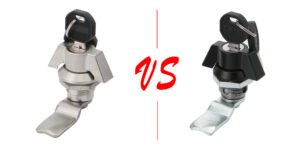
A lock that’s perfect for an office filing cabinet will fail inside a coastal electrical enclosure. The two materials you’ll actually choose between are stainless steel (304/316) and zinc alloy (Zamak) — and the right answer depends entirely on where the lock lives.
| Factor | Stainless Steel (304 / 316) | Zinc Alloy (Zamak) |
|---|---|---|
| Corrosion resistance | Excellent, ideal for humid / outdoor / coastal | Good for indoor, moderate environments |
| Strength & durability | High, resists deformation | Moderate, cost-effective |
| Cost | Higher | Lower |
| Best for | Outdoor enclosures, marine, food/medical equipment | Indoor cabinets, general industrial |
How to verify: ask for the material certificate (mill test report) and confirm the specific grade. “Stainless” without a grade number is a vague claim.
Red flags: the supplier can’t specify the grade, or quotes stainless pricing for a part that’s clearly zinc alloy in the photo.
Learn more about our material options on our cabinet lock product page.
3. Certifications & Compliance — Check What Your Market Requires
Different markets and industries demand different proof. Buying blind here is how shipments get held at the border or rejected by your end customer’s audit.
The certifications that matter for industrial locks:
- ISO 9001 — baseline quality management system.
- CE — required for many electrical enclosures entering the EU.
- RoHS / REACH — restriction of hazardous substances, critical for the European market.
- Material certifications — mill test reports for stainless grades.
How to verify: request the actual certificate files (not just a logo on the website) and check the validity dates and scope. A reliable supplier keeps these ready because they ship to regulated markets constantly.
Red flags: expired certificates, certificates that don’t list the specific product category, or “we can provide anything you need” without showing it.
4. Quality Control & Testing — Ask What They Actually Measure
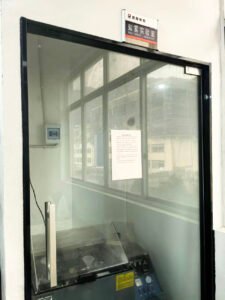
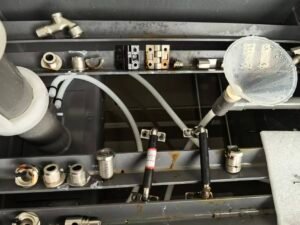
Price differences between suppliers often come down to how much testing they skip. A lock that passes a visual check can still fail in the field from weak spring tension or poor plating adhesion.
What a serious manufacturer tests:
- Salt spray test — confirms plating and corrosion resistance (e.g., 48–96 hours per standard).
- Torque / cycle life test — how many open-close cycles before failure.
- Dimensional inspection — ensures interchangeability across batches.
- Batch traceability — can they tell you which lot a defective unit came from?
How to verify: ask for a sample test report and their AQL (Acceptable Quality Limit) level. Request that incoming material and outgoing products both get inspected.
Red flags: “we check everything by eye” or no documented AQL, no batch records.
5. MOQ & Lead Time Flexibility
Low MOQ sounds attractive, but the real question is whether the supplier can scale with you — and whether they can handle a rush order without collapsing quality.
How to evaluate:
- Confirm the true MOQ per item, not a teaser number for one SKU.
- Ask about standard lead time and their peak-season capacity (pre-Chinese-New-Year is when most delays happen).
- Find out if they keep common items in stock for faster turnaround.
Red flags: vague lead times (“about two weeks”), or a supplier who can only do huge volumes and rejects small trial orders entirely.
Practical tip: many buyers place a small trial order first to test both product and responsiveness before committing to a container.
6. Customization & Engineering Support
If you’re an OEM or building a proprietary enclosure, off-the-shelf locks often won’t fit. The supplier’s ability to customize — and to support your engineering team — becomes a differentiator.
What to look for:
- In-house tooling / mold-making for custom cam locks, latches, and hinges.
- Willingness to produce from your drawing or co-develop a sample.
- Short sample lead time (a good maker turns a sample in days, not months).
How to verify: send a rough sketch and ask what they’d need to quote. Their questions will tell you whether they understand the engineering.
Red flags: “we only sell standard items” when you need a modified actuator, or no engineering contact at all.
7. Communication & After-Sales
The cheapest lock becomes expensive when nobody answers your email about a defective batch. Communication quality is a leading indicator of how a supplier handles problems.
Evaluate:
- Response time and English proficiency of the sales/engineering contact.
- A clear warranty and replacement policy in writing.
- References or case studies from buyers in your region or industry.
Red flags: slow or evasive replies during the sales phase (it only gets worse after payment), no written warranty, no verifiable track record.
Buying Advice by Application
- Outdoor / coastal / marine enclosures: prioritize 316 stainless, salt-spray tested, with material certificates.
- Indoor electrical cabinets: 304 stainless or quality zinc alloy, depending on budget and environment.
- Medical / food equipment: stainless with RoHS/REACH compliance and full traceability.
- High-volume OEM: focus on customization support (Point 6) and consistent batch QC (Point 4).
The 3 Most Expensive Mistakes Buyers Make
- Choosing on price alone — the gap usually comes from skipped testing or lower-grade material.
- Skipping the sample stage — a $50 sample order prevents a $20,000 bad shipment.
- Not verifying the factory — paying factory prices to a trading company with no production control.
How to Score Suppliers with This Checklist
A checklist only helps if you use it to compare, not just to read. Before requesting quotes, set up a simple scorecard: put your candidate suppliers across the top and the 7 points down the side. Give each point a 1–5 score based on what they actually showed you — certificates on file, a real video tour, a sample test report, a written warranty.
Weight the points to your own risk. If you ship to the EU, certifications (Point 3) and material proof (Point 2) should carry more weight than price. If you’re an OEM, customization support (Point 6) moves to the top of the list.
The goal isn’t to find a perfect 35/35 supplier — that rarely exists at small MOQ. It’s to eliminate the ones who can’t produce evidence for the points that matter to your application, then negotiate with the survivors on the things that are genuinely flexible: lead-time buffers, payment terms, and first-order MOQ.
A supplier who scores well on capability and QC but quotes slightly higher usually costs less in the long run than a cheap one who fails Point 4 after your first container.
Your Next Step
Turn this checklist into a working tool. We’ve packaged the 7 points — plus a supplier scorecard and the exact questions to ask in a quote request — into a free Cabinet Lock Sourcing Checklist 2026.
Download the Checklist (email required) — or send us your RFQ and we’ll walk you through Points 1–7 against your specific application.