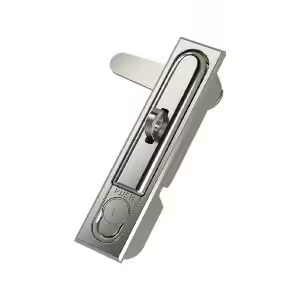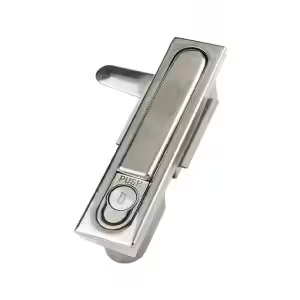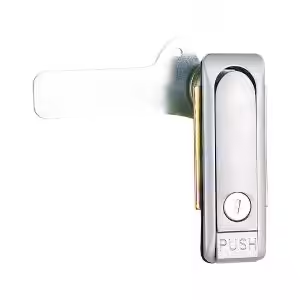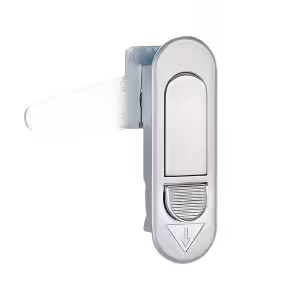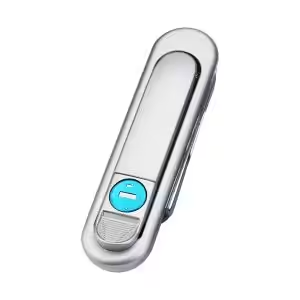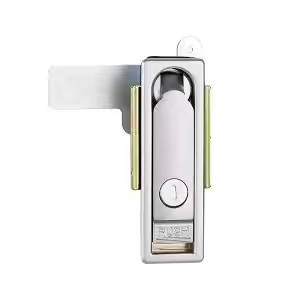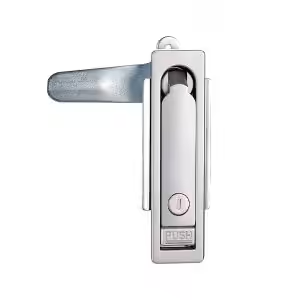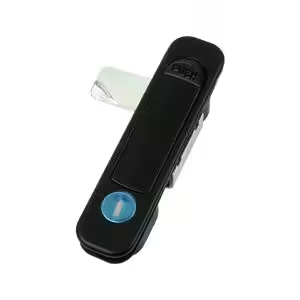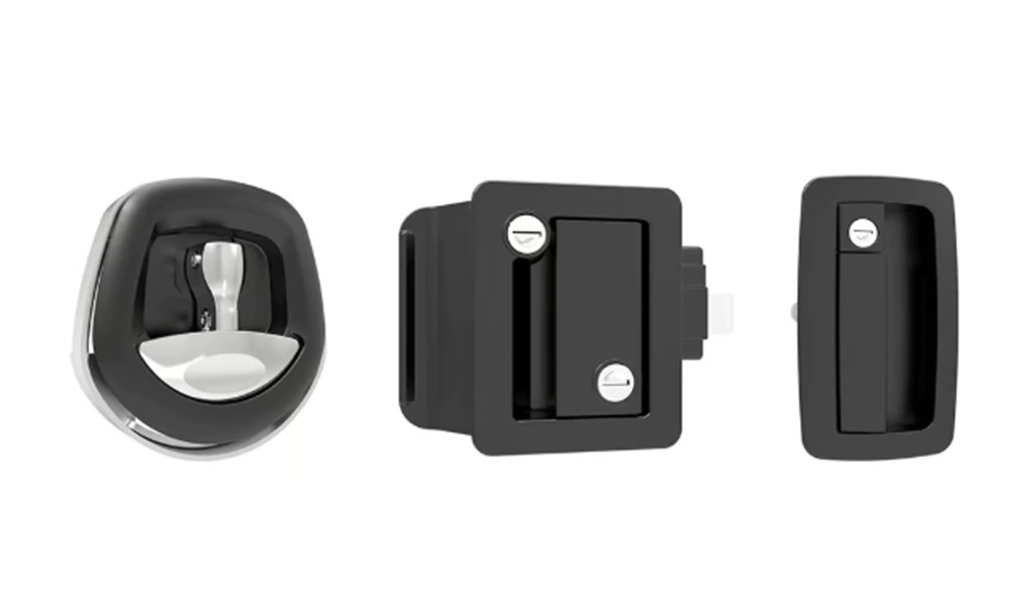
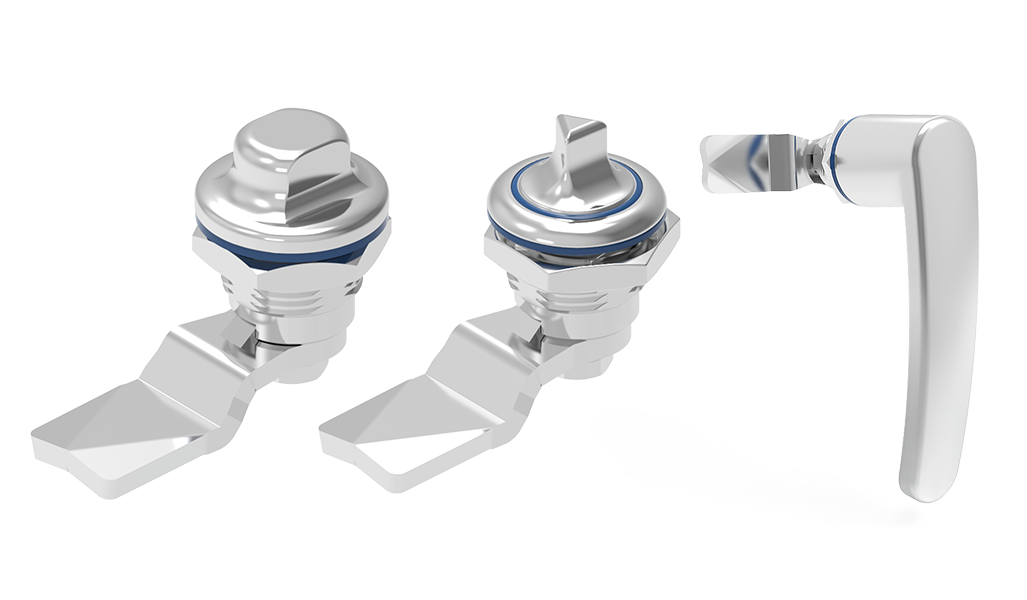





Walk down any row of server racks, telecom cabinets, or outdoor electrical switchgear enclosures, and almost every tall door uses the same piece of hardware: a swing handle lock. At a glance, it looks like a sleek, flush-mounted lever tucked into a vertical escutcheon plate. Turn the key or press the release button, and the handle pops out; swing it 90 degrees, and the entire cabinet door unlatches.
Here is the straightforward mechanical answer: a swing handle lock works as a two-stage mechanical actuator—a key cylinder or push-button release first unlocks the handle so it can pivot outward from its recessed housing, and rotating that handle 90 degrees drives an internal cam or multi-point rod linkage to release the door from the frame.
In our daily work at CUYUE designing and manufacturing industrial cabinet hardware, we see why engineers rely so heavily on swing handles for large enclosures: they give operators genuine hand leverage to overcome stiff door gaskets while staying completely flush when locked so nobody catches a sleeve or breaks a protruding handle in a narrow aisle.
Inside a Swing Handle Lock: The Four Core Working Parts
To see how a compact vertical housing controls an entire cabinet door, look at what happens behind the faceplate:
The Recessed Housing (Escutcheon): Mounts into a standardized rectangular panel cutout—typically sealed against the door skin with a perimeter flange gasket and shaft O-rings to meet IP65 / NEMA 4 environmental protection requirements.
The Security Lock Core (Cylinder / Insert): Houses a keyed cylinder (such as a standard Euro-profile cylinder, CH751/keyed-alike core, or master-keyed barrel), a tool-operated insert, or a padlockable hasp. When locked, a small internal blocking bolt holds the handle flush inside the housing.
The Pivoting Swing Lever: Hinged at the top or bottom of the housing. Once released by the key or button, it flips outward roughly 45 degrees so your hand can grip it comfortably.
The Rear Drive Mechanism (Single-Point Cam or Multi-Point Gear): Connected directly to the handle’s rotational spindle. When you turn the handle 90 degrees clockwise or counter-clockwise, the spindle translates your hand motion into latching action inside the cabinet.
Step-by-Step: The Operating Sequence
Opening and closing a swing handle cabinet lock follows a clean, repeatable mechanical cycle:
Step 1 – Unlocking the Handle: Insert and turn the key (or press the release button on non-keyed models). Inside the housing, the cylinder cam retracts a small retaining catch, allowing the spring-assisted handle to pop slightly forward out of its flush recess.
Step 2 – Flipping the Lever Out: Pull the handle outward on its pivot pin until it stops at an ergonomic angle, giving you solid mechanical leverage.
Step 3 – Rotating 90 Degrees to Unlatch: Swing the handle 90 degrees left or right. This rotates the central drive spindle, pulling the internal cam pawl—or the top and bottom locking rods—away from the cabinet frame strikes.
Step 4 – Closing and Re-Locking: Shut the cabinet door, swing the handle back 90 degrees to engage the cam or rods behind the frame, and press the handle flat back into its housing until the lock cylinder clicks shut (or turn the key to deadlock it).
Single-Point vs. Multi-Point Swing Handle Systems
Not all swing handle locks engage the cabinet frame the same way. Choosing the right internal drive depends almost entirely on door height and sealing pressure:
| Drive Configuration | How It Latches the Door | Best Application |
| Single-Point Cam Drive | Rotating the handle swings a single cam pawl behind the frame at mid-height | Short-to-medium doors (under ~1,000 mm) on compact control boxes and wall-mount enclosures |
| 3-Point Rod Control System | A central gear or actuator plate drives upper and lower vertical latching rods simultaneously with the center cam | Tall server racks, power distribution cabinets, and outdoor telecom shelters where top and bottom corners would otherwise bow away from the gasket |
| Compression Swing Handle | Adds axial pull-up travel during the final degrees of handle rotation to squeeze the EPDM gasket tight | Outdoor and washdown enclosures requiring strict IP65 dust/water sealing and zero vibration rattle |
Practical Engineering Note: On a 2-meter-tall electrical cabinet, relying on a single center latch leaves the top and bottom corners free to flex outward under wind load or gasket back-pressure. A 3-point swing handle lock distributes clamping force along the entire latch edge with one single turn of the wrist.
Material Choices and Real-World Durability
Because swing handle locks combine a moving pivot pin, a lock cylinder, and high-torque drive gears inside a relatively slim profile, material selection directly affects service life:
304 and 316 Stainless Steel: The go-to choice for marine cabinetry, coastal telecom boxes, food processing enclosures, and corrosive outdoor environments where painted finishes would chip and rust.
Powder-Coated or Chrome-Plated Zinc Alloy: Widely used across indoor data center racks, industrial automation panels, and HVAC cabinets where crisp casting detail, smooth actuator feel, and cost efficiency matter most.
Reinforced Polyamide (Nylon): Lightweight, non-conductive, and naturally corrosion-resistant—ideal for electrical metering boxes and composite enclosures.
Why Precision Tooling Matters in Swing Handle Locks
Anyone who has dealt with a cheap swing handle knows the warning signs immediately: a sloppy handle that rattles inside its housing, a key cylinder that binds when the door gasket pushes back, or a spindle that strips under heavy operator torque. Those headaches almost always come down to loose casting tolerances, weak pivot pins, or unverified cycle durability.
At CUYUE, we are a comprehensive industrial locking hardware manufacturer backed by a dedicated R&D and design team, specializing in cabinet locks, industrial hinges, and handles. With complete in-house product R&D, mold development, manufacturing, and product testing and verification capabilities, we engineer swing handle locks and complete industrial locking system solutions built to meet growing customer demands for consistent quality, rapid delivery, customization, and disciplined cost control.
Looking to specify standard or custom swing handle locks, multi-point rod systems, or matching industrial hinges for your enclosures? Connect with the CUYUE team to discuss your cabinet hardware requirements.