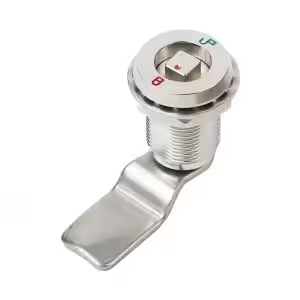
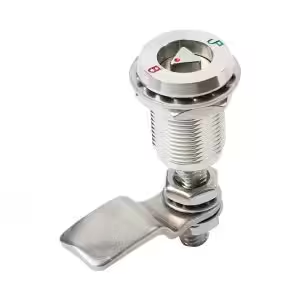
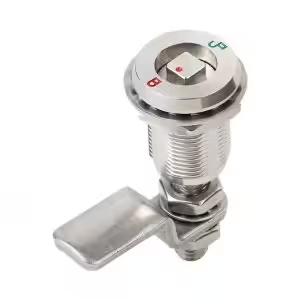
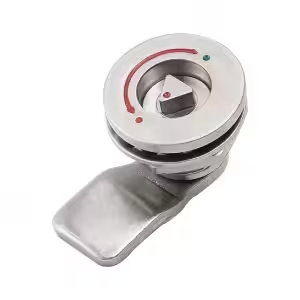
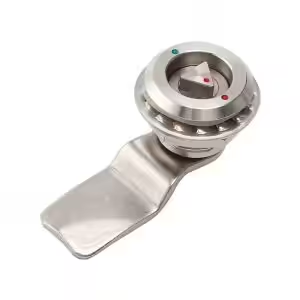
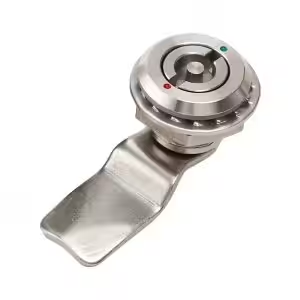
A compression cam latch is a mechanical locking device that combines two functions: locking and compression. Unlike a standard cam lock, which mainly secures a cabinet door, a compression cam latch also pulls the door tightly against its frame to help compress the sealing gasket.
This mechanism is commonly used in electrical cabinets and industrial enclosures where secure closure and effective sealing are important.

How Does a Compression Cam Latch Work?
The CUYUE C3-1617 compression cam latch operates through two separate 90° rotations, with a total rotation of 180°.
Step 1: First 90° — Locking
When the key is turned 90°, the cam rotates behind the door frame and engages the locking surface. At this stage, the door is mechanically locked, but the compression action has not yet been completed.
Step 2: Second 90° — Compression
Turning the key another 90° activates the compression mechanism. The cam moves axially, pulling the door closer to the frame.
For the C3-1617, this axial movement is 7 mm. The pulling action helps compress the gasket between the door and frame, improving contact between the sealing surfaces.
Step 3: Unlocking
To unlock, turn the key in the opposite direction. The first 90° releases the compression, while the next 90° rotates the cam away from the frame, allowing the door to open.
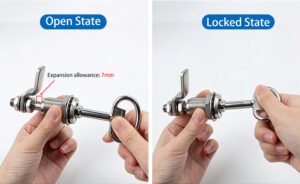
What Does 7 mm Compression Travel Mean?
The C3-1617 features 7 mm of axial compression travel. This refers to the movement of the latch mechanism during the compression stage.
However, 7 mm of mechanical travel does not necessarily mean that the gasket is compressed by exactly 7 mm. Actual gasket compression depends on the door-to-frame distance and the gasket design.
[Image 3: Comparison of unlocked and compressed positions]
Why Use a Compression Cam Latch?
The compression mechanism offers three practical advantages:
Secure closure: The cam engages the frame and helps hold the door in place.
Improved sealing contact: The pulling action helps compress the gasket against the frame.
Reduced door movement: Proper compression can help minimize rattling caused by equipment vibration.
Unlike a conventional cam lock, a compression cam latch provides an additional pulling action after the cam reaches its locking position.
Conclusion
A compression cam latch works by first rotating the cam into the locking position and then applying axial compression to pull the door toward the frame.
The CUYUE C3-1617 demonstrates this principle through two 90° rotations and a 7 mm compression travel, providing both mechanical locking and controlled door compression for industrial enclosures.